
Introduction
A cricket scorecard tells you who is ahead, how each player performed, and what the chasing team needs. Whether you follow television coverage, a score app, or a platform using a Cricket ID, the basic terms remain the same.
Start with the team total, wickets, and overs. Then read the batting figures, bowling figures, and match situation.
The examples below are hypothetical and focus mainly on T20 and ODI cricket.
1. Read the Team Score and Match Format
A score of India 156/4 means India have scored 156 runs and lost four wickets. It does not mean four runs were deducted.
Check the format:
- T20: normally 20 overs per side.
- ODI: normally 50 overs per side.
- Test cricket: up to two innings per team, with different result possibilities.
The format determines how much batting time is available.
2. Understand Overs and Balls Correctly
18.3 overs means 18 completed overs and three legal balls, not 18.3 mathematical overs.
Because an over contains six legal deliveries:
- 18.3 overs = 111 legal balls.
- In a 20-over innings, nine legal balls remain.
- For calculations, 18.3 overs equals 18.5 overs.
Wides and no-balls do not count toward the six legal deliveries. This explains why you may see more than six deliveries in an over.
3. Decode the Batting Columns
| Heading | Meaning | Example |
|---|---|---|
| R | Runs scored | 45 runs |
| B | Balls faced | 30 balls |
| 4s | Number of fours | Four fours |
| 6s | Number of sixes | Two sixes |
| SR | Runs per 100 balls faced | 150.00 |
Strike rate = runs ÷ balls faced × 100.
A batter scoring 45 from 30 balls therefore has a strike rate of 150. Boundary columns count shots, not boundary runs: four fours contribute 16 runs.
A star beside a batter’s score commonly means not out. Symbols beside names can have other meanings, so check the legend.
4. Read How Batters Were Dismissed
Common abbreviations explain the dismissal:
- c Sharma b Khan: caught by Sharma off Khan’s bowling.
- b Khan: bowled by Khan.
- lbw b Khan: dismissed leg before wicket off Khan.
- st Sharma b Khan: stumped by wicketkeeper Sharma off Khan.
- run out: dismissed through a run-out.
DNB means “did not bat,” not a score of zero. A batter listed as not out has not been dismissed in that innings.
5. Understand Bowling Figures and Extras
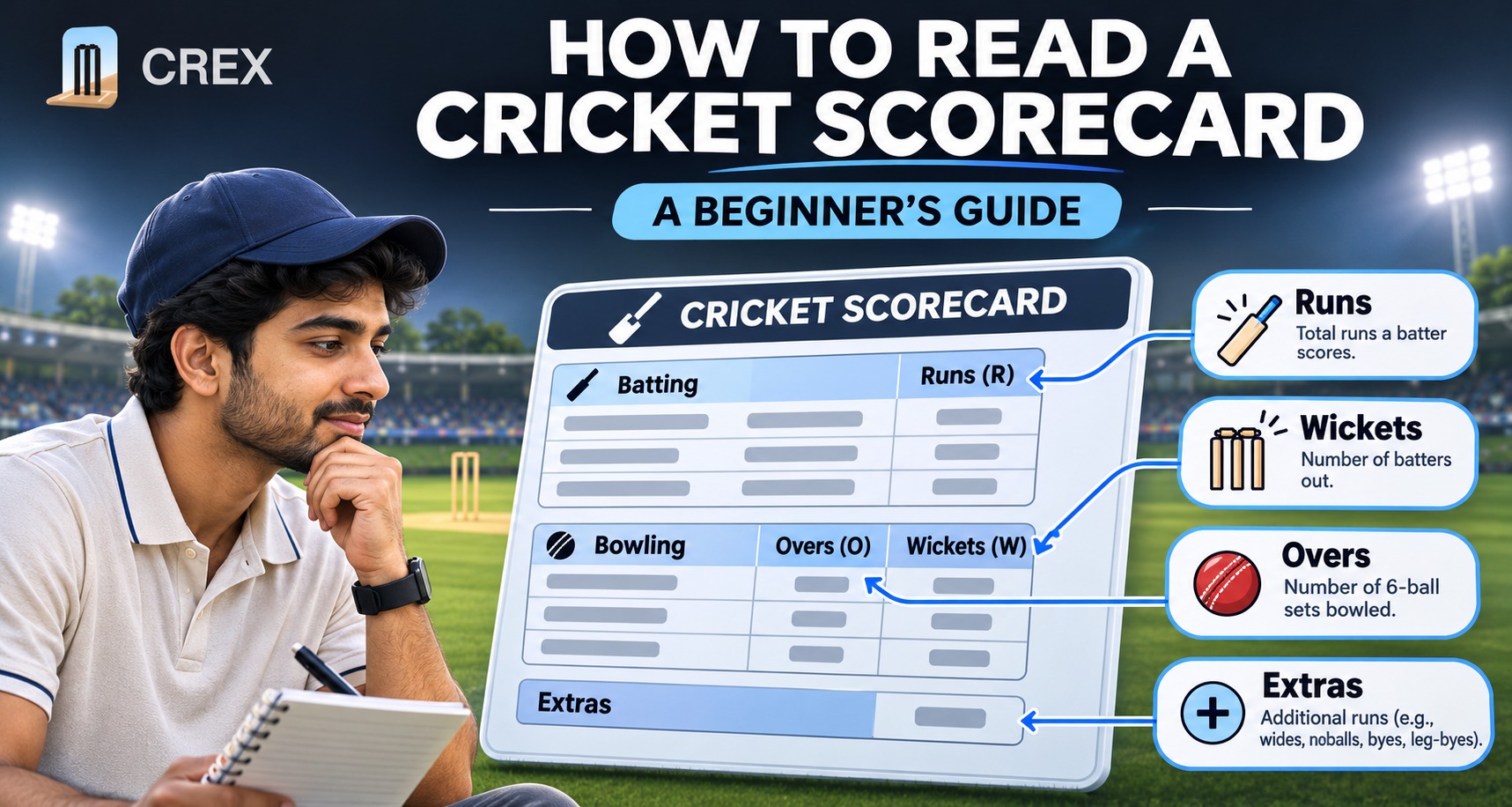
Bowling figures commonly follow O–M–R–W:
| Heading | Meaning |
|---|---|
| O | Overs bowled |
| M | Maiden overs: no runs charged to the bowler |
| R | Runs charged to the bowler |
| W | Wickets credited to the bowler |
Figures of 4–0–28–2 mean four overs, no maidens, 28 runs conceded, and two wickets. The economy rate is 28 ÷ 4 = 7.00.
A run-out counts toward team wickets but is not credited to the bowler.
Extras include b (byes), lb (leg-byes), wd (wides), nb (no-balls), and applicable penalty runs. Batters’ runs plus extras equal the innings total.
6. Compare the Current and Required Run Rates
The current run rate shows runs scored per over so far. The required run rate shows the scoring pace needed to reach a target within the remaining overs.
Suppose India are 120/3 after 15 overs, chasing 161 in a T20:
- Current rate: 120 ÷ 15 = 8.00.
- Runs needed: 161 − 120 = 41.
- Balls remaining: 30.
- Required rate: 41 ÷ 5 = 8.20.
Readers following a Cricket exchange should keep these figures separate: neither rate is a prediction of the result.
7. Check Partnerships, Wicket Falls and the Result
Fall of wickets: 75/2 at 9.4 means the second wicket fell at 75 runs after nine overs and four legal balls.
A partnership records runs added while two batters are together, including extras.
In Tests, check innings labels, leads, deficits, and d for declared. In rain-affected limited-overs matches, use the displayed revised target rather than the original target.
Read More : Cricket Exchange App Guide to Live Scores and Match Insights
Conclusion
Read a scorecard in this sequence: total, wickets, overs, batting, bowling, and target. Practise with one completed match, then explain its result using those figures. This turns abbreviations into a clear account of the game.
FAQs
What does 50 off 35 mean?
The batter scored 50 runs from 35 balls.
Is 19.5 overs five balls short of 20?
No. It is one legal ball short.
Why do batting runs differ from the total?
Extras are added to the batters’ combined runs.
What does winning by six wickets mean?
The chasing team reached its target with six wickets remaining.
Is required run rate the same as net run rate?
No. Required rate concerns a chase; NRR compares aggregate scoring and conceding rates in a competition.