Introduction
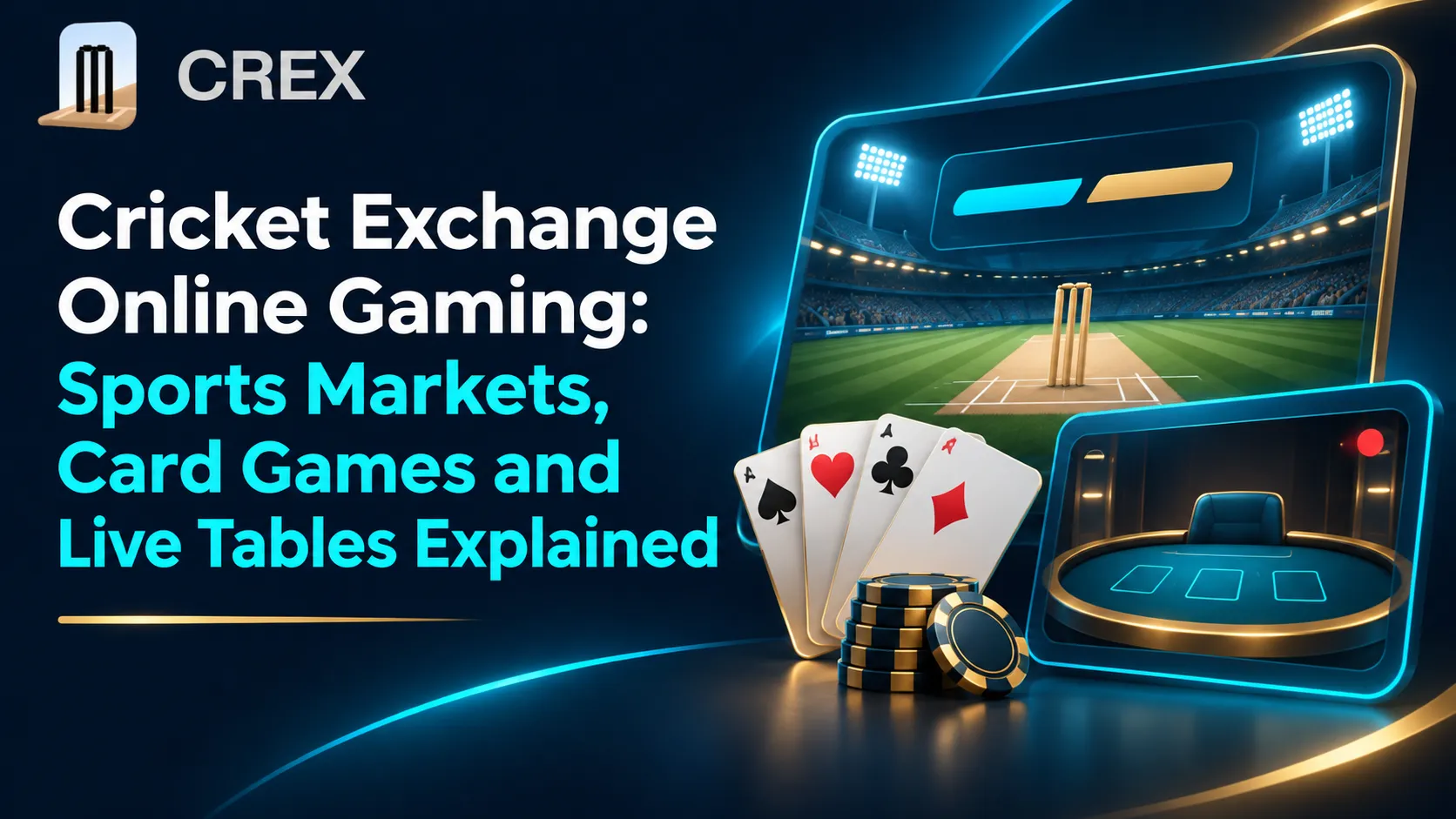
Sports markets, card games and live tables describe different aspects of online entertainment. This Cricket exchange guide explains what each term means, where the categories overlap and which details help readers understand them correctly.
Sports markets concern events in a sporting contest. Card games describe a type of game. Live tables describe how a game is presented and conducted. A card game can therefore also be a live-table game.
Before researching a Cricket ID, distinguish the information website from the operator responsible for any account or game.
What Does Cricket Exchange Provide?
The website describes itself as an information and comparison resource covering account access, sports markets and related gaming features. It states that it does not operate the third-party platforms discussed in its comparisons.
Consequently, a listing or article should not be interpreted as confirmation that every feature is available through one universal account. Account-specific questions belong with the identified provider.
Sports Markets, Card Games and Live Tables: Quick Comparison
| Category | What it describes | Illustrative example |
|---|---|---|
| Sports market | A defined outcome or statistic in a sporting event | Match winner or innings runs |
| Card game | A game involving cards and a particular rule system | Baccarat or blackjack |
| Live table | A format using a streamed dealer or physical game equipment | Live baccarat or roulette |
| Digital table game | A software-based version of a table game | RNG-generated card dealing |
These examples explain categories, not the verified catalogue of a particular provider.
Understanding Sports Markets
A sports market defines a question about a match or competition. It should identify the outcome, period covered and conditions used to determine the result.
Common cricket examples include:
- Match winner: The specified match outcome.
- Innings runs: A team’s total within a named innings.
- Player runs: Runs credited to an individual within the stated scope.
- Bowler wickets: A named bowler’s wicket tally.
- Tournament winner: The overall competition result.
Why the Complete Description Matters
“Total runs” could refer to one over, one innings or both teams combined. Similarly, “top batter” might concern one team or the whole match.
Check how interruptions, participation and tie-breakers are treated. For example, one operator’s published rules include a Super Over in match-result settlement while excluding its statistics from ordinary team and player totals. That treatment should not be assumed universal.
Understanding Card Games
Card games do not all use the same scoring, decision-making or outcome rules. Read the rules for the exact version rather than transferring assumptions from another game.
Baccarat as an Example
In standard punto banco baccarat, two hands—Player and Banker—are compared. Aces count as one, cards from two to nine retain their value, and tens and picture cards count as zero.
Only the final digit of the total counts. For example, seven plus eight produces a hand value of five. Fixed drawing rules determine whether another card is dealt.
The broader lesson is that familiar cards do not imply familiar rules. Variants may also change commissions, payouts or additional selections.
What Are Live Tables?
Live tables generally combine physical game activity with a digital interface and video presentation.
The UK Gambling Commission distinguishes live-dealer games from computer-generated games whose results are produced using a random number generator.
A live table is therefore a delivery format rather than one particular game. Baccarat can appear in both live-dealer and software-based versions.
Seeing a dealer does not independently verify the operator, game certification or regulatory status. Those require separate evidence.
How Do RNG-Based Games Differ?
RNG stands for random number generator. In software-based games, it helps generate outcomes according to the game’s design.
The UK regulator’s technical standards set requirements for random outcomes within its licensing framework. Those standards should not be presented as certification of an unrelated website or application.
When reviewing a game, identify its developer, published rules and any verifiable testing information. An animation alone does not explain how the outcome was generated.
What Should Indian Readers Check?
India’s current framework distinguishes permissible online social games and e-sports from prohibited online money games. Government guidance states that money games involving chance, skill or both fall within the prohibition.
Category names such as “card game,” “sports market” or “live table” do not establish permission to offer a particular service.
Before submitting information, check:
- The operator’s identity and service status.
- The exact rules and version.
- Whether the outcome comes from a sporting event, physical equipment or software.
- Privacy and account-recovery arrangements.
- The published complaint process.
A Cricket ID describes account access; it does not independently establish these facts.
Conclusion
Sports markets define event-related outcomes, card games follow their own rules, and live tables describe a presentation format. Understanding those distinctions makes a Cricket exchange comparison easier to read and helps users identify the information still needing verification.
Frequently Asked Questions
Are card games and live tables separate categories?
They overlap. A card game such as baccarat can be conducted at a live table.
Does “live” mean there is no delay?
No. Live video can involve processing and delivery delays.
Does one account necessarily access every listed service?
No. Confirm access arrangements with the identified operator.
Does a game listing confirm availability or legal permission?
No. Both require separate verification.